Showing posts with label podcasts. Show all posts

Saturday, 1 August 2015

The Day the Earth Smiled

This somehow passed me by when it happens (perhaps caught up with the upcoming move to Australia) but the latest episode of the Infinite Monkey Cage podcast (series 12, episode 4) featured a short segment on “The Day the Earth Smiled”.

From the Cassini Imaging website:

On July 19, 2013, in an event celebrated the world over, NASA’s Cassini spacecraft slipped into Saturn’s shadow and turned to image the planet, seven of its moons, its inner rings – and, in the background, our home planet, Earth.

The CICLOPS site has the full picture. This section is from the Wikipedia page and has Earth marked with an arrow.

Pretty humbling stuff.

There’s more at CICLOPS including a higher resolution image of the Earth and Moon:

Sunday, 1 December 2013

You're not what you eat but you are what eats what you eat

The old adage that “you are what you eat” is not really true unless you are thinking at an atomic level. Even here, a lot of stuff passes straight through you or is absorbed only to be filtered out again because it is toxic and/or you have too much of it. The exception, perhaps, is bacteria.

Bacteria get a bit of a rough ride from most humans, largely because most of the bacteria that we have been historically aware of - and interested in - have been harmful to our health. Apart from saving humanity from the Martians, what have bacteria ever done for us? Well, lots to be honest and we certainly wouldn’t be here without them. Not just that but we would be without them.

As highlighted in this week’s BBC Discovery podcast, one of the most important realisations of the past few years has been the importance of what we call the “human microbiome”, i.e. the total microbial (e.g. bacterial) complement of the human ecosystem - and an ecosystem is exactly what you and I are. The idea of a human navigating his or her way through the world as an individual animal - occasionally under attack by parasites - is an idea that is pretty firmly fixed in our sense of self but it is really a falsehood.

The “friendly bacteria” of yakult etc. have popularised the notion that not all bugs are out to get us and that some of them are actually our allies but I still think that most people are probably unaware of the role they play and just how crucial they are to our health (and, when things go wrong, ill health). In many ways, an individual person is more bacterial than human. Not in terms of biomass, it is true, (for bacteria are small) but in sheer numbers the microbes have it: 10 trillion cells may sound like a lot but there are approximately 100 trillion bacteria in the average human. A lot of fuss has (rightly) been made of the Human Genome Project but a human only has around 21,000 protein-coding genes plus a whole bunch of non-coding ones making a total somewhere in the order of 100,000 different genes (no one knows for sure yet). The diversity of bacterial genes in your body is harder still to measure but is estimated to be 100 times this number at around 10 million. (An individual bacterium has far fewer genes that a human cell but there are many different species/strains of bacteria living within you.)

These bugs are important too and play critical roles in priming your immune system, defending you from other unfriendly bacteria and, perhaps most importantly, helping you to digest your food. Indeed, the biggest concentration of bacteria is in the intestine and the population here is heavily influenced by diet - part of the reason that a major shift in diet can cause some upsets down there. Furthermore, evidence now links a healthy gut population with a healthy person, and poor diets have been implicated as possible contributors to poor health beyond simple nutritional deficits. As a consequence, fecal transplants are now being touted as possible cures for all sorts of gastric conditions.

So next time you find it hard to motivate yourself to have a varied, balanced diet, spare a thought for your microbiome!

[Picture from matt over matter, where you can read even more about the human microbiome.]

Friday, 21 June 2013

What do a Lurcher called Zak and a cheetah have in common?

Actually, these animals have lots in common - they are both mammals, carnivores etc. - but I'm thinking of something a bit more esoteric: both have had their locomotive performance measured by a special collar designed by Alan Wilson and the Structure & Motion Laboratory at the Royal Vetinary College in London. (The same technology was also used for the collars that tracked 50 cats from Surrey in the recent BBC Horizon, “The Secret Life of the Cat” programme, which is well worth a watch!)

The team have used the collars to study cheetah hunting behaviour, which was recently published in Nature and featured in the June 13th Nature podcast. The study itself is interesting and demonstrates how raw speed - the big thing the cheetah is famed for - is actually secondary to agility and power (i.e. acceleration and deceleration) when it comes to hunting success. Even so, the wild cheetahs still chalk up bursts of up to 59 mph (93kph) whilst hunting, which is not too far off the 65mph (105kph) top speed recorded in zoos.

The bit that really appealed to me, however, was how the collars were tested prior to being deployed in the field, which I find pleasingly elegant and effective. Prof Wilson’s pet lurcher, Zak, was given a run about on the beach whilst wearing a collar. (Two actually, as the new collar was being compared to older technology as well.) The data from the collar was then used to reconstruct Zak’s movements, which could be compared to the footprints left in the sand!

(The handsome chap in the photo above is not actually Zak but Dexter, my sister-in-law’s lurcher, on Dollymount Strand with a nice view of Howth in the background.)

Find more details of the study in Nature news, the podcast and, of course, the paper itself:

Wilson et al. (2013). Locomotion dynamics of hunting in wild cheetahs. Nature 498, 185–189.

There’s also some coverage on Why Evolution is True that appeared whilst this post was sitting in drafts.

Friday, 7 June 2013

Putting Archaeopteryx back on its perch?

Around this time last year, the sad news came out that South Korean textbook publishers were removing examples of evolution following pressure from Creationists. [Soo Bin Park (2012) South Korea surrenders to creationist demands. Nature 486:14.] One of the examples to be dropped was Archaeopteryx, on the grounds that it might not be an ancestral bird after all. I am not sure how they will respond to last week's news that recent research puts Archaeopteryx back in the bird lineage, as opposed to being "just another feathered dinosaur". (Just‽)

The study in question, A Jurassic avialan dinosaur from China resolves the early phylogenetic history of birds [Godefroit et al., Nature (2013) doi:10.1038/nature12168], describes a 170-million-year-old fossil (below). Twenty million years or so older than Archaeopteryx, Aurornis xui is touted as the earliest definite early bird. (Artist's reconstruction, above.) Furthermore, the traits it shared by the two seem to put Archaeopteryx fully back within the ancestral avian lineage.

The authors include one of my Southampton colleagues, Gareth Dyke, and you can hear him discuss the paper on the Nature Podcast at the Nature News article, New contender for first bird. You can also read a summary in the Science news of the week - Science 340:1024-1025, Earliest Birdie? [Pictures from the linked Nature and Science news items.]

Of course, whether or not Archaeopteryx is an ancestral bird or not, that does not alter the irrefutable fact that birds did evolve from dinosaurs. The real solution to the challenge by Creationists should not have been to take Archaeopteryx out of the textbook but to put more fossils into the textbook. Teach the actual "controversy", such as it is: from which dinosaurs did birds evolve?

Saturday, 20 April 2013

Nature launches "pastcasts" with 1953 DNA papers - and unsung hero of the story, Raymond Gosling

The Nature Podcast has added a new series: the Nature Pastcast, which revisits key papers from the Nature archives. The first episode looks at the famous 1953 Watson & Crick paper and the other two DNA papers from the same issue.

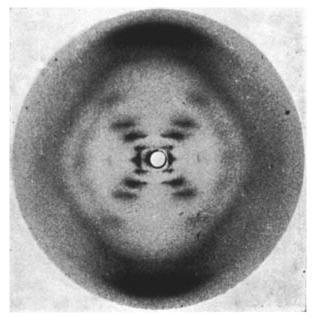
Watson and Crick are rightly famous for the discovery of the structure of DNA. Maurice Wilkins, who was senior authors on one of the other papers in the issue and showed Watson the famous X-Ray diffraction image of "B DNA" ("Photograph 51" [image, above right, from Wikipedia]) shared the Nobel prize with Watson and Crick.

Everyone also seems to know about Rosalind Franklin, whose group took the X-Ray image (but did not appreciate its significance) and many people was cheated of a Nobel prize because it is not awarded posthumously. There was another key player that I had never heard of until today, though, Raymond Gosling.

Having listened to the podcast, if anyone should have shared the glory of the discovery it was Gosling. It was he who took the famous Photograph 51 and he who gave it to Wilkins, who in turn showed it to Watson. Franklin, it seems, was primarily interested in solving the "A" form of DNA, of which this was not an image. You can hear more of his story in his own words in a Nature Podcast Extra interview. Interesting stuff.

Monday, 25 February 2013

Become a Founder Member of the new Rationalist Association website

The Rationalist Association has a new website at http://rationalist.org.uk/, which is packed full of articles and podcasts etc. Many of these are from the excellent New Humanist magazine. The site is still under development but the goal is to establish a vibrant online community and so they are currently offering a free opportunity to become a Founder Member and help shape its future. If you are into promoting reason, debate and free thought, why not sign up? I have!

Friday, 22 February 2013

A sprayful of sugar helps the vegetables go down

Continuing the vegetable theme from the last post (and I should have more cabbage-related posts), the Science podcast this week had an interesting method for encouraging kids to eat their greens. It seems that the solution is to use a sugar spray on vegetables to mask their bitterness, to which children are apparently more sensitive. Valerie Duffy from the University of Connecticut presented the findings at the American Association for the Advancement of Science Annual Meeting, Multi-Level Interventions To Improve Vegetable Consumption in Children. As reported in the ScienceNOW section of the Science Magazine website, A Little Sugar Helps the Broccoli Go Down:
"Bitterness can be minimized in several ways. Even a small amount of sugar spooned into a cup of coffee, for example, will send a strong signal to the brain. Salt blocks the sensation in the mouth, as does acidity. Fat coats the taste buds and prevents the offending molecules from reaching them; that's one reason salad dressings are popular around the world. Duffy and several colleagues conducted a laboratory study of some of these approaches in 37 adults. When the volunteers munched on asparagus, Brussels sprouts, and kale, sweetness was most effective at increasing the appeal of the vegetables. And only sugar was able to change the opinion of people who hadn't liked Brussels sprouts or kale".
It's about getting kids to develop a taste for vegetables that they then carry with them through later life, and the amount of sugar needed does not really make it a concern:
"All that's needed is a fraction of a teaspoon, just enough to balance the bitterness. In addition, after the kids have eaten the sweetened vegetables a few times, sugar can be eliminated and they will continue liking the vegetables, according to studies published by other researchers"
Following the recent horse-meat scandal in Europe, I am thinking that anything that encourages people to eat more fresh vegetables rather than processed junk has got to be a good thing.

Tuesday, 12 February 2013

Roses are red but are they green?

Although I have always known that buying roses on Valentine's Day is a romantic cliche that shows a lack of imagination, what I did not realise is that it usually also shows a serious lack of environmental awareness. Although I regularly think about the environmental impacts of food and fuel, I must admit that I've never really thought about flowers before. (OK, so I don't think about flowers too much in general but I do sometimes buy them!)

In yesterday's "60-Second Earth" Scientific American Podcast, "Roses Raise Environment Concerns", they draw attention to the negative environmental impacts of roses, from direct impacts of habitat destruction and water/pesticide usage to the carbon footprint of transport and refrigeration.

This is not news - Scientific American itself previously had an article in 2009, "Blooms Away: The Real Price of Flowers", exploring some of these issues. It is news to me, though, as is the idea that roses are particularly bad - presumably because of the excessive demand at an inappropriate (from a growth perspective) time of the year.

As with all environmental issues, however, it's also quite complicated. As the 2009 article states:
"First off, don't assume that imported roses are environmentally hostile. A 2007 study by Cranfield University in England found that raising 12,000 Kenyan roses resulted in 13,200 pounds (6,000 kilograms) of CO2; the equivalent number grown in a Dutch hothouse emitted 77,150 pounds (35,000 kilograms) of CO2. Both examples include energy used in production and delivery by plane and/or truck. The roses from Holland required artificial light, heat and cooling over the eight- to 12-week growing cycle, whereas Africa's strong sun boosted rose production by nearly 70 percent over those grown in  Europe's flower auction capital."
If you do want to give flowers then the best thing is probably to consider getting them from a company like Florverde:
"Florverde Sustainable Flowers FSF® are grown responsibly by growers. This means they follow best practices to protect the environment and their workers."
Likewise, if giving jewellery, consider a Fair trade supplier, like CRED. (Order by Wednesday for UK Valentine's Day delivery. We got our wedding rings from them so I wanted to give them a mention!)

It's not always easy to consider the environmental impact of our activities (and I could certainly do more) but when it comes to luxury goods like flowers and jewellery, I think we have a particular responsibility to do the right thing. It's the thought that counts, so spare a thought for the environment this Valentine's Day.

Wednesday, 19 December 2012

Piltdown man: hoax but no giant conspiracy

A century ago today, "Piltdown Man" and associated finds were announced at a Geological Society meeting. It subsequently turned out to be one of the biggest scientific hoaxes of all time, though it was not discovered for over 40 years and we still don't know who did it, or why. (Although there are suspects.) I'm not going to recap the details here because the Natural History Museum and recent Nature Podcast Extra do a much better job than I can. (And WEIT!)

It's a good reminder to all of us in science, however, not to get too carried away with novel discoveries until they have been thoroughly verified. It seems pretty clear that a number of the scientists involved in Piltdown were thoroughly duped and tragically so in some cases. I think it is sometimes easy to forget that not everyone has the level of scientific or personal integrity that we hope all scientists aspire too.

It is also a good reminder of something else, though, which is encouraging in this modern age of Bad Pharma, continuing misrepresentations of evolution and relevations of scientific fraud: with science, the truth will generally out in the end. Piltdown Man was a hoax but human evolution is real and it was predominantly further finds and evidence that cast aspersions on Piltdown's authenticity until new technologies finally revealed it as an unequivocal fraud. What's more, despite its importance in the past, this was not hushed up or swept under the carpet. In the modern age, with its pressures for instant press releases and hurried high impact publications, I take great comfort in that.

Despite some claims to the contrary, there is no giant scientific conspiracy for, in the long run, as scientists we have nothing to gain.

Wednesday, 3 October 2012

Are big pharma companies worse than homeopaths?

Ben Goldacre is well known for busting Bad Science and promoting evidence-based medicine. His latest book, Bad Pharma, goes beyond quackery and takes on Big Pharma, highlighting what are down-right dangerous practices in the industry. I haven't read the book but his recent article about it in the Business section of the Guardian, "The drugs don't work: a modern medical scandal", makes scary reading. You can also hear him talk about it in a recent Nature Podcast Extra.

It's common knowledge that Homeopathy is pure placebo and literally has no active ingredients. The danger of homeopathy is not that it will do you any harm - there is nothing in there to do any harm - but rather that people will be conned into using Homeopathy in place of treatments that could actually cure them. (Not all conditions can be treated effectively with a placebo and some drugs out there genuinely do work better than placebo.)

The same is not true of drugs. (Or herbal remedies for that matter.) They contain an active ingredient and therefore there is the very real potential for harm as well as the very real potential for an actual positive effect. It is therefore much worse to find out that Big Pharma companies are playing games with the clinical trials and evidence on which doctors base their treatments.

Big Pharma, Homeopaths and woo merchants are all in the business of making money and so it is perhaps not surprising that they use some of the same tricks to sell their wares but what is surprising (to me) is the extent to which the law lets them get away with it and regulating authorities are apparently powerless to do anything about it. Although it does nothing to undermine the need for evidence-based medicine, it massively undermines the access to evidence-based medicine - if the evidence the doctors get access to is hidden or distorted then what's the point?

It's a pretty stark picture. Indeed, Ben Goldacre starts the book thus:
"Medicine is broken. And I genuinely believe that if patients and the public ever fully understand what has been done to them - what doctors, academics and regulators have permitted - they will be angry... I'm going to tell you how medicine works, just over the page, in one paragraph that will seem so absurd, so ludicrously appalling, that when you read it, you'll probably assume I'm exaggerating."
Before I get to that paragraph, I would say that there is at least one other group that will be (and are!) angry - other academics. I am one! I am angry as both a sometimes patient and a scientist. (And, when it comes to medicine, a member of the public!)

The reason this angers me as a scientist are two-fold. First, the trivially obvious reason: such flagrant abuses of methods that are supposed to provide objective evidence not only undermine public faith in medicine but they undermine faith in science as a whole. (Not, sadly, that non-medical science is immune to these abuses but they generally seem to get identified by other scientists, who are all skeptics by nature, and rarely have the same capacity for harm.) The second reason is that it is not just doctors and patients that use these data. There is a lot of effort being put into mining existing drug actions and side effects to identify novel treatments (e.g. "network medicine") - often by people who do not stand to make money from the discovery. The weakness with all of these approaches is that "rubbish in, rubbish out" and if the pharma industry is systematically sabotaging the data that the scientific community are using for such endeavours then a lot of good scientists are wasting valuable time and money, not to mention missing important connections that could result in genuine treatments.

But now for that paragraph. You can read the full paragraph using Amazon's Look Inside feature but here's a taster:
"Drugs are tested by the people who manufacture them, in poorly designed trials, on hopelessly small numbers of weird, unrepresentative patients, and analysed using techniques which are flawed by design, in such a way that they exaggerate the benefits of treatments. Unsurprisingly, these trials tend to produce results that favour the manufacturer. When trials throw up results that companies don't like, they perfectly entitled [legally, not morally - RJE] to hide them from doctors and patients, so we only ever see a distorted picture of any drug's true effects. Regulators see most of the trial data, but only from early on is a drug's like, and even then they don't give this data to doctors or patients, or even to other parts of government. This distorted evidence is then communicated in a distorted fashion..."
The rest of the paragraph - and, judging by the intro, the book - is not much cheerier. It's no wonder he says that Medicine is broken. When I am feeling brave, I think I will order a copy for my kindle.

Nevertheless, I think there is something worth pointing out or reiterating: this is a problem of implementation, not theory. It is not that drugs cannot or do not work - some do and we have well-designed and well-executed studies that show this. (Generally, the older ones, when Pharma was not so desperate or, perhaps, cynical and there was more low-hanging fruit.) It is not that medicine should not be evidence-based or that we do not have methods for gaining that evidence. This does most emphatically not mean that homeopaths and woomeisters were right all along. The fact that some of their conspiracy theories have a semblance or truth about them does not mean that their pseudoscientific nonsense suddenly gains merit.

I'm not really sure what can be done about this but the first step on the road to recovery is admitting that you are sick, and it certainly cannot be swept under the carpet. Part of me still hopes that Ben Goldacre's new book is an exaggeration (or, at least, concentrates on all the negatives) but can we really take that chance? However widespread the problem in terms of current drugs that are affected, we must make some changes to things that are clearly broken. Making the clinical trials process entirely independent of drug companies would be a start and forcing drug companies to publish all of their data from trials for analysis by independent experts seems like such a no-brainer that my mind still boggles a little at the revelation that it isn't so.

Should it be needed, it's just another indicator of the dangers of privatising health care. When the bottom line is money not effectiveness, you know you are in trouble.

Sunday, 9 September 2012

The Life Scientific of Richard Dawkins

Richard Dawkins is one of my personal heroes. Although I do not always agree with everything he says, I usually agree with most of it and he has been a source of inspiration at many points in my life. Reading his classic book on gene-centric evolution, The Selfish Gene, was like having a light switched on. I was fascinated in evolution and genetics before then - I was in the first year of a degree in Genetics at the time - but suddenly it all just made sense. It's still a book I recommend.

Another one of my favourite books of all time is The God Delusion. It sums up the position of a rational agnostic atheist incredibly well. A lot of people argue against it, and vilify Dawkins because of it, but I have never actually seen a good argument against what he writes. (Usually, people are arguing against something that he didn't write. I sometimes wonder whether any of the anti-Dawkins crowd have actually read anything by him.)

If you are one of those people - or a fan, like me - then I strongly recommend downloading this week's episode of The Life Scientific and listening to his half hour interview with presenter Jim Al-Khalili. I am always impressed about how calm and rational he is, and not at all strident as his detractors proclaim in ignorance. This is a man who clearly loves nature - the magic of reality - and loves science - the "poetry of reality". Another great BBC podcast.

Tuesday, 4 September 2012

Putting Greenwich at the centre of the World

If, whilst watching the Equestrian events at Greenwich Park, you wonder how Greenwich got to be home to the Prime Meridian Line - and thereby determine both world time and world longitude - you could do much worse than Episode 91 of A History of the World in 100 Objects, which features the ship's chronometer from HMS Beagle.

It represents technological advancement that didn't get a mention in the opening ceremonies but was arguably much more important than putting men on the moon (as Steve Jones did argue) or robots on Mars. (As undeniably cool as those things are!)

I've been slowly working my way through the episodes of this great series over the past few months - there are a lot of them! - and was particularly pleased to listen to this one yesterday as Darwin and Deep Time both get a mention. (I'd just been updating the MapTime Organic Evolution TimeLine and Keywords.)

So, if you are in London and looking to kill some time between events, download the podcast (or read the transcript) and then visit the British Museum!

Friday, 31 August 2012

Tim Minchin talks to Caitlin Moran

I've probably been living under a rock or something because I have never really come across Caitlin Moran before. I've just listened to Tim Minchin talk to Caitlin Moran on BBC Radio 4's "Chain Reaction" (it wasn't quite an interview!) and it was great!

It's only available on iPlayer for 5 more days and it's well worth a listen. (The previous episode in which Derren Brown interviewed Tim Minchin was pretty good too but I think that one's gone already. Perhaps it will reappear somewhere?)

She has some great things to say on a variety of topics including modern feminism and "ethical" free-range celebrity gossip. Although I'm not one, it really made me want to read How to be a Woman and, on the basis of this podcast, I would recommend that you do too! (It won an award and everything.)