Showing posts with label molecular biology. Show all posts

Saturday, 26 March 2016

Meet the world's newest lifeform: Syn 3.0

Every now and then, a piece of science is done that is truly ground-breaking and world changing. One such piece is:

Hutchison III CA et al. (2016) Design and synthesis of a minimal bacterial genome. Science 351(6280): aad6253-1. DOI: 10.1126/science.aad6253

Science has a summary here but it’s worth reading the whole paper. Syn 3.0 itself is pretty impressive, but what’s even more impressive is the approach taken to make it. In addition to using current knowledge of fundamental biological machinery, the Venter group used large-scale transposon mutagenesis and selection to identify additional genes that were either essential (i.e. no growth without them) or “quasi-essential”, where removal resulted in a major growth deficit.

They also had to overcome the problem of redundancy: even in a genome as reduced as the Mycoplasma species, there can sometimes be multiple genes that do the same thing. Removing one makes little difference but removing both is lethal - something hard to identify when knocking out single genes at a time. Whatever the Intelligent Design crowd would like to believe, biology is messy.

Of course, Syn 3.0 is just the start, as the goal was making a “minimal cell”:

“A minimal cell is usually defined as a cell in which all genes are essential. This definition is incomplete, because the genetic requirements for survival, and therefore the minimal genome size, depend on the environment in which the cell is grown. The work described here has been conducted in medium that supplies virtually all the small molecules required for life. A minimal genome determined under such permissive conditions should reveal a core set of environment-independent functions that are necessary and sufficient for life. Under less permissive conditions, we expect that additional genes will be required.”

Robust life will therefore need a lot more genes. It will be interesting to see how many are required for autotrophy - life that needs only inorganic chemicals and an energy source.

Even within the “minimal cell” concept, Syn 3.0 represents a somewhat arbitrary end-point. In identifying the “quasi-essential” genes, a judgement had to be made regarding what constitutes an acceptable growth rate*. Whittling down to 473 genes is impressive, but this number could no doubt be even smaller if slower growth rates were accepted. (Modern life is in competition with lots of other highly evolved organisms. Early life would have been able to get by with much lower growth rates, so this is not a “minimal cell” in that context.)

There is also a lot of exciting potential ahead for manually reducing the number of genes by true intelligent design. Fusing interacting gene products together, for example, might eliminate the need for so many genes contributing to core processes. (Looking for apparent protein fusion/fission events in evolution is a reasonably successful method for predicting protein-protein interactions.) With time, we might be able to “wind back the clock” and remove some of the unnecessary complexity that has probably crept into the system due to the underlying evolutionary process.

I also wonder how many of the current crop of genes of unknown function - a surprising 149 genes - can be replaced over time with genes of known function. (In other words, how many of them represent convergent evolution of functions we already know about but are not recognisable.) And how many of the rest are genome-/condition-specific?

Like all of the best science, this work opens the door to more questions than it answers! Some exciting times ahead, I think.

[*The important but oft-overlooked concept that any assessment of life is context- and environment-dependent exposes another flaw with Intelligent Design as a testable hypothesis: designed to do what? To assess how well-designed something is, one needs to know its purpose and/or the acceptable design traits. To hide from the fact that Intelligent Design is Creationism, supporters often make the argument that the identity of the designer (Creator) is not important - but without knowledge of the designer, how can one predict the motivation behind the design?]

Friday, 5 December 2014

Edwards Lab: On the hunt for molecular mimicry in viral pathogens

Yesterday’s excellent Australian Pathogen Bioinformatics Symposium 2014 (#APBS2014) reminded me that this post was a bit overdue: originally posted at the UNSW Science Wavelength blog on October 30, 2014. Following APBS2014, we are also looking into how we can identify which other pathogens might be using a similar strategy.

Read more at the Edwards Lab blog…

Thursday, 18 September 2014

Why are kinases called kinases?

Kinases are one of the biggest and most important classes of enzymes (i.e. protein with catalytic activity) in biology. You can always recognise an enzyme because of the suffix “-ase”. What comes before the -ase then indicates the nature of the enzymatic activity.

The major classes of enzyme have names that give a good clue as to the general nature of this activity. Oxidoreductases, for example, catalyse oxidation-reduction (“redox”) reactions. Transferases transfer chemical groups from one molecule to another. Kinases are transferases: they transfer a phosphate group from one organic molecule (usually ATP, the cell’s primary energy carrier) to another (a protein, lipid or carbohydrate). And this is actually the origin of the kin- part of the name: from the Greek kinein “to move”.

For those wondering, there is also such as thing as a Phosphorylase but this does something subtly different; whereas a kinase transfers organic phosphate groups (i.e. phosphates attached to carbon-based biomolecules), a phosphorylase transfers inorganic phosphate groups (i.e. phosphate+hydrogen) to acceptor biomolecules.

But why -ase? This stems from the ending of diastase, the first enzyme ever discovered. According to Wikipedia:

“The name “diastase” comes from the Greek word διάστασις (diastasis) (a parting, a separation) because when beer mash is heated, the enzyme causes the starch in the barley seed to transform quickly into soluble sugars and hence the husk to separate from the rest of the seed.”

So there you have it. A kinase is an early example of an enzyme that moves something from one molecule to another, hence a name that literally means “an enzyme to move”.

Sunday, 19 January 2014

The $1000 genome is here... Kind of...

I’m not an avid follower of tech news but something that popped up on my radar this week seemed worthy of a blog post. As Bio-IT World reports in What You Need to Know About Illumina’s New Sequencers, Illumina have announced the first sub-$1000 human genome:

Sequencing costs have been coming down steadily and dramatically since the invention of “Next Generation” techniques and the “$1000 genome” - a full human genome for under $1000 - has long been one of the holy grail targets of cheap sequencing. The cost-per-genome that Illumina quote does indeed represent a substantial drop:

This is not for everyone, as you need to buy at least ten machines as a “HighSeq XTM Ten package at $1 million a piece.

According to the Illumina press release:

The HiSeq X Ten is the world’s first platform to deliver full coverage human genomes for less than $1,000, inclusive of typical instrument depreciation, DNA extraction, library preparation, and estimated labor. Purpose-built for population-scale human whole genome sequencing, the HiSeq X Ten is an ideal platform for scientists and institutions focused on the discovery of genotypic variation to enable a deeper understanding of human biology and genetic disease. It can sequence tens of thousands of samples annually with high-quality, high-coverage sequencing, delivering a comprehensive catalog of human variation within and outside coding regions.

The $1000 price tag only applies “when used at this scale” and it doesn’t say anything about computational costs - storing and processing the vast quantities of data coming of the machine. For many sequencing applications, the computational cost now exceeds the sequencing cost, although I suspect that genome re-sequencing is at the cheaper/easier end of the processing spectrum. Which brings me to the other aspect of my “kind of…” qualifier: the HighSeq XTM still only produces 150bp reads, and at 30x coverage. This is ample for certain applications and will enable you to re-sequence (i.e. use an existing genome sequence as a scaffold to map the short reads onto) most of a “normal” human genome. It will probably struggle, however, when looking at repetitive sequences. Sequencing a genome de novo (i.e. without a template for assembly) will not be possible at the sub-$1000 price tag. Likewise, samples with heterogeneity, such as cancer genomes, need much more that 30x coverage.

As a bioinformatician, announcements like this fill me with a mixture of excitement and dread. Don’t get me wrong: being able to generate so much more data is great. The problem is, we need to be able to do something with all that data. Short 150bp read data is, ultimately, quite limiting: you need loads of it to get decent coverage/assembly and you are always going to be stuck where greater lengths are required to discriminate between repeats etc. Processing, quality-controlling, filtering and assembly these short reads remain a bioinformatic headache. This is definitely progress but, personally, I am still waiting for long-read single molecule sequencing before I get too excited.

Thursday, 21 November 2013

RIP Fred Sanger (1918-2013)

I opened my email this morning to the news that Fred Sanger had died. This was not entirely surprising, given that he was 95, but still sad. Although I have never met him, I think it is fair to say that I am one of many scientists whose careers have been shaped and influenced by the work of this great scientist.

I still remember sitting in lectures as an undergraduate and discovering how “Sanger” sequencing worked - like many of the ideas that change the world, it was gloriously simple and yet spectacularly clever. And, I think it is fair to say, it changed the face of biology forever.

Indeed, that was back in 1977, and Sanger sequencing is still used all over the world today, even in the face of stiff competition from “Next Generation” methods. It was the sequencing method (albeit in a much tweaked and automated version) that got us the Human Genome and one of the world’s leading sequencing centres - the Wellcome Trust Sanger Institute at Hinxton, outside Cambridge - still bears his name.

The centre has a press release about the “remarkable man”, which has been written by greater wordsmiths than I:

“Fred Sanger, who died on Tuesday 19 November 2013, aged 95, was the quiet giant of genomics, the father of an area of science that we will explore for decades to come.

His achievements rank alongside those of Francis Crick, James Watson and Rosalind Franklin in discovering the structure of DNA. We are proud that he graciously agreed to allow our Institute to be named after him.

In research marked by two Nobel Prizes, he developed methods that allow us to determine the order of the building blocks of DNA and of proteins. This technique allowed the languages of life to be read.

Because of Fred’s work we have been able to interpret those languages and to use that knowledge for good.”

There is more, including quotes and links out to other resources about his work, at the site.

I remember thinking in those lectures back in Nottingham how I wished that one day I might have an idea as good as Sanger sequencing. I doubt that I ever will; instead, I will just have to settle for trying to do the best I can with all of the amazing sequence data that now exists as a result.

Friday, 26 April 2013

Happy DNA Day!

It's 60 years to the day since the trio of Nature papers about the structure of DNA were published, including the famous 1953 Watson & Crick paper. The double helix has to be one of the most elegant and beautiful of all natural phenomena. The Exploratorium website has an annotated version of the Watson and Crick paper if you fancy a read. It's pretty short and contains one (or two) of the biggest understatements in biological history:
"This structure has novel features which are of considerable biological interest. ... It has not escaped our notice that the specific pairing we have postulated immediately suggests a possible copying mechanism for the genetic material."
Indeed!

Saturday, 20 April 2013

Nature launches "pastcasts" with 1953 DNA papers - and unsung hero of the story, Raymond Gosling

The Nature Podcast has added a new series: the Nature Pastcast, which revisits key papers from the Nature archives. The first episode looks at the famous 1953 Watson & Crick paper and the other two DNA papers from the same issue.

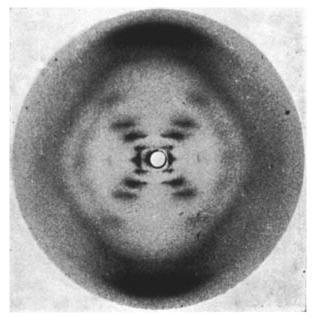
Watson and Crick are rightly famous for the discovery of the structure of DNA. Maurice Wilkins, who was senior authors on one of the other papers in the issue and showed Watson the famous X-Ray diffraction image of "B DNA" ("Photograph 51" [image, above right, from Wikipedia]) shared the Nobel prize with Watson and Crick.

Everyone also seems to know about Rosalind Franklin, whose group took the X-Ray image (but did not appreciate its significance) and many people was cheated of a Nobel prize because it is not awarded posthumously. There was another key player that I had never heard of until today, though, Raymond Gosling.

Having listened to the podcast, if anyone should have shared the glory of the discovery it was Gosling. It was he who took the famous Photograph 51 and he who gave it to Wilkins, who in turn showed it to Watson. Franklin, it seems, was primarily interested in solving the "A" form of DNA, of which this was not an image. You can hear more of his story in his own words in a Nature Podcast Extra interview. Interesting stuff.

Saturday, 30 March 2013

SMBE has a shiny new website

I'll always have a bit of a soft spot for the journal "Molecular Biology and Evolution" (MBE). Not only does it combine two of my favourite things - molecular biology and evolution - but it was also where I published the main paper from my PhD, Transiently beneficial insertions could maintain mobile DNA sequences in variable environments. Although published by Oxford Journals, MBE is a journal of the Society for Molecular Biology & Evolution (SMBE), which also organises a large annual conference of the same name.

SMBE has a nice shiny new website at http://www.smbe.org/. As well as news on this and blog posts on relevant topics, you can also see the most read papers from MBE and SMBE's other journal, Genome Biology and Evolution (GBE). You can also keep up to date with SMBE via their new Twitter Stream and Facebook page. (The current Secretary and Treasurer of SMBE are both members of VIBE, the Virtual Institute of Bioinformatics & Evolution (formerly the "Virtual Institute of Bioinformatics, Eire"), through which I got my first postdoc, so it must be good! I miss VIBE meetings!)

Thursday, 28 March 2013

Geek Sculpture at Cold Spring Harbor Laboratory

A couple of weeks ago, I attended the 2013 "Systems Biology: Networks" meeting at Cold Spring Harbor Laboratory, New York.

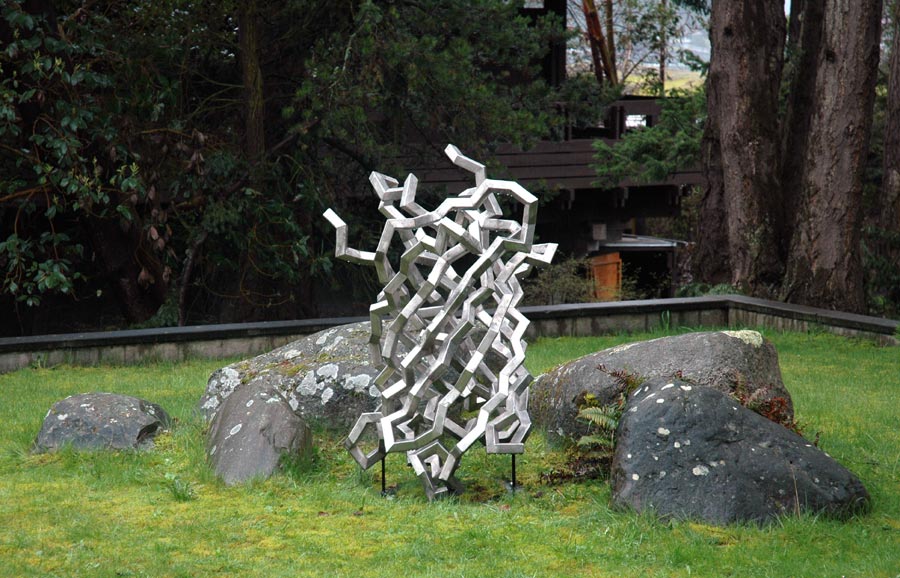
Cold Spring Harbor Laboratory has a beautiful little campus on the north shore of Long Island, about an hour or so east of New York city. One of its charms is the many pieces of sculpture dotted around the place, including "The Waltz of the Polypeptides" by Mara G. Haseltine, which we passed each time we travelled between our cabin dorm and the talks or food.

As the plaque states:
"The Waltz of the Polypeptides" is the artist's impression of the birth of a protein. As five ribosomes travel the length of a messenger RNA, a protein is created.
It's quite cute and the large subunit of the ribosome looks like it wants a hug once it's released from the mRNA, as seen to the right of the above photo.

The protein in question is identified as Beta Lymphocyte Stimulator (a.k.a. BLyS a.k.a. B-cell activating factor (BAFF)), officially called tumor necrosis factor (ligand) superfamily, member 13b (TNFSF13B). A separate sculpture of the protein backbone sits on the other side of the path. I like it!

(I stayed on for some holiday after the conference - hence the lack of posts recently - so expect a few more travel posts soon.)

Thursday, 6 September 2012

ENCODE: highlighting the best and worst of science in the modern world

A massive ENCODE publication release was made yesterday, including 30 papers, an iPad App (downloaded and looking good) and a Virtual Machine full of data. I'm not going to give my opinions on the findings here because, frankly, there's too much to digest. Instead, I recommend reading Ed Yong's summary and the thoughts of Ewan Birney. [Image pinched from Ed Yong.]

ENCODE is an amazing example of what humanity can achieve it is puts time, effort and resources into a coordinated scientific endeavour - and also a reminder (should we need one) of how much more there is to learn about our genome. My mind is blown just thinking about reading all the papers and trying to make sense of them. (I wish I could clear my diary for a few days but deadlines loom!)

ENCODE is also a stark reminder of what it means to do science in the 21st Century world of bloggers, tweeter and general bitchers who just like to take quotes and soundbites out of context and then moan about them. The ability of some folk to digest 30 data-dense papers in a few hours (or minutes) and then have an informed opinion about them - and why they are wrong - is astounding.

So, my second recommendation is this: ignore the hype and all the nonsense flying around about what Ewan Birney meant by "functional" (he explains if you bother to read) and what this means for "junk" DNA. (Probably not much - I am sure it still exists, there just might be quite a lot more functional bits and long-range interactions than we thought - but let's let science and investigation answer that one.) Ignore all this and read the papers (if you're a scientist or committed lay person) or wait for the dust to settle for some reasoned, rational responses (if you are lacking the time/capacity/inclination to tackle 30 papers plus extras). Concentrate on the content and not the language. (I suspect a lot of it comes down to your definition of "junk" and "functional". I don't think I would choose the definitions that they have but, as the authors, it is their prerogative to define their terms and the serious reader's responsibility to make sense of the articles in that context.)

It's going to be years before we make sense of all this new data and work out how much of it is important. Years of wonderful, real science, not soundbites and speculations. As any ground-breaking study is likely to do, ENCODE has raised far more questions than answers - what (if anything) are all these DNA elements doing? Get excited by those questions and start thinking about how we can answer them. Keep your mind open to the possibilities and don't just shoot them down because they make you - or your future discourse with Creationists - uncomfortable.

So, could Ed and Ewan been more careful about the "80% functional" quote? Yes. Should they have been? I'm not so sure. Creationists are having a field day with it but so what? Whatever the finding, Creationists will try to twist it to their goals. That's one of their defining characteristics. If we change how we do or report science to pander to that particular bunch of deluded crackpots, we hand them victory. (Ewan explains his choice and, whether you agree or not, it was his choice to make. Our choice, is how we interpret the quote and whether we bother to find out what he actually meant before slagging it off.)

As a final footnote, I had the pleasure of meeting Ewan Birney once at a conference in Hinxton and the man is phenomenal. As with all great scientists, he is not going to be 100% right 100% of the time but ignore or scoff at him at your peril.

Saturday, 2 June 2012

What is a gene?

In addition to complaints about a lack of peer-reviewed publications, one of the frequent complaints and/or sources of misunderstanding regarding the arguments of Richard Dawkins is his use of the word "gene". Much like his use of the "God" in "The God Delusion", Dawkins has a specific meaning for "gene" in "The Selfish Gene" and the gene-centred view of evolution. Just as many of the objections levelled at "The God Delusion" ignore (or are ignorant of) his definition of "God", many of the objections levelled at gene-centric evolution ignore (or are ignorant of) his definition of "gene". So, what is a Gene? And why is there so much confusion?

Part of the problem is that gene means different things to different people and I think that this can be traced right back to the word's origins. The term "gene" was coined by Wilhelm Johannsen in 1909 as "special conditions, foundations and determiners which are present [in the gametes] in unique, separate and thereby independent ways [by which] many characteristics of the organism are specified” [quote taken from "What is a gene, post-ENCODE? History and updated definition" (Gerstein et al. 2007)], which has subsequently been paraphrased by others as "the fundamental physical and functional units of heredity". The problem, I think, stems from physical and functional.

Physical is fairly obvious and we now know that DNA is the genetic molecule of heredity. Molecular biologists and biochemists tend to fixate on this aspect of the "gene". A gene is a specific locus of the DNA that encodes a particular function. Even here, there is much debate and confusion over what constitutes a gene, which is unfortunately (and perhaps ironically) fuelled by a tendency for lower level biology textbooks to only talk about protein-coding genes to the extent that First Year undergrads seem to insert a silent (and invisible) "protein-coding" in front of "gene" whenever they see it or use it. Many genes do not encode proteins and a strong case could be made that things we frequently call "genes" are not fundamental units of heredity due to recombination etc. (See Gerstein et al. 2007 for more on this aspect of the problem.) The reason we have the words "cistron", "locus", "allele" etc. is because "gene" does not do well as a catch-all term for all situations. Although important, it is not the physical aspect I want to focus on, though.

Functional is not so simple due to the gene's (unique?) status as an information-carrying replicator - the essence of The Selfish Gene. Both the physical copy and the information contained by it can (rightly) be described as "the gene" depending on the situation. In terms of evolution rather than molecular biology, the emphasis is clearly on the information and not the physical molecule. It is this latter carrier of information that evolutionary biologists (including Richard Dawkins) are generally referring to with the term "gene". (Explicitly, Dawkins uses definition of George Williams, whose ideas formed the basis of The Selfish gene, as "that which segregates and recombines with appreciable frequency.") There just happens to be a lot more molecular biologists than evolutionary biologists in the world (including a subset with an explicit objective to erode the importance of the gene as a driver of evolutionary change and adaptation - a physical gene does not challenge Creationism in the same way that a heritable unit of information does.) The biochemist's physical definition might be winning the war for popular definition but this other term is still a common meaning if you think for a moment of the meaning of the phrase "gene pool", which is still used quite frequently.

The problem with the word "gene" is the same problem that always arises when we have a word for a useful concept that translates poorly into the real world as a set of explicit and consistent rules. "Gene" is a bit fuzzy because the physical reality of a fundamental unit of functional importance is context-dependent and hard to define, as is the functional reality of a fundamental unit of heredity.

The best solution, in my opinion: (1) unless it is blatantly obvious, make it clear what definition of "gene" you are using when making an argument on which it depends, and (2) be damn sure that you know what definition someone else is using before you start attacking their arguments. Semantics is a killer that isn't going to go away.

Thursday, 2 February 2012

Translation UK 2012 website now live

The website for the Translation UK 2012 conference is now live:
A meeting bringing together researchers in translational control and other aspects of mRNA metabolism.
Tuesday 3rd and Wednesday 4th of April at the University of Southampton
Online booking is not quite ready but the registration deadline is Feb 20th, so start planning your submission now if you want to come!

Thursday, 5 January 2012

Great Fluorescent Proteins

One of the benefits of teaching (and its ugly sibling, marking,) is exposure to interesting bits of science that I would normally not have the time and/or inclination to find out more about. One such thing is the most excellent - and Nobel Prize winning - Green Fluorescent Protein (or "GFP").

I am not a structual biologist and often find myself getting a bit bored at the minutiae of structural details that excite biochemists at lunchtime seminars but I must admit that I find the structure of GFP to be a thing of geeky beauty. GFP has what is known as a beta barrel or "can", which is comprised of a number of beta strands (a particular arrangement of protein strands that make a kind of sheet) wrapped into a tube (or barrel). Within this barrel, sits some modified amino acid residues called the "chromophore", which are responsible for the fluorescent aspect of GFP. This is then protected by caps at the top and bottom of the barrel.

I don't feel too bad about liking this - Julian Voss-Andreae liked it enough to make a sculpture!

GFP works by absorbing light of one wavelength and emitting light of another. In the case of the original GFP from jellyfish, UV or blue light is absorbed and green light is emitted, hence GFP. (The blue light itself is generated by another protein (aequorin), which is "chemiluminescent" and emits light in response to a chemical stimulus - in this case, a release of calcium in response to external stimulation. GFP and aequorin were first isolated from "squeezate", which is what you get when you pass jellyfish through some gauze!)

Other colours also exist, both in nature and as a result of tinkering by various scientists over the years. As well as enabling some fun "lab art", such as this "San Diego beach scene" created in the lab of Nobelist Roger Tsien [Artwork by Nathan Shaner, photography by Paul Steinbach] made using eight different fluorescent proteins, including a Red Fluorescent Protein (RFP) from corals that I have done a bit of work on. (I'll save that for another time.) I love the names of some of the colours too: "BFP, mTFP1, Emerald, Citrine, mOrange, mApple, mCherry and mGrape". (Mmmmmm.... Cherry.)

This diversity has led to some amazing research tools that have in turn led to some amazing discoveries, hence the Nobel prize. There are far too many to list here but one such technique that I make indirect use of in my own work is "FRET": "Fluorescent (or Förster) Resonance Energy Transfer", which is used for (among other things) detecting likely protein-protein interactions. It works a bit like the original GFP in jellyfish, using the emission of light from one protein to trigger fluorescence in the other. Unlike the jellyfish, however, FRET uses a GFP-like protein for each step. Each FP is attached to a different protein of interest and light is provided that excites the first protein. If the two proteins get close enough, such as if they interact, the emission from the first protein excites the second protein and the emission spectrum shifts, allowing the interaction (or, more accurately, proximity) to be detected.

Perhaps more fun are some of the recreational uses of the GFP family of proteins, such as these "GloFish", which demonstrate the power of genetically modification in a fun and friendly way. (Take that, Pope!)


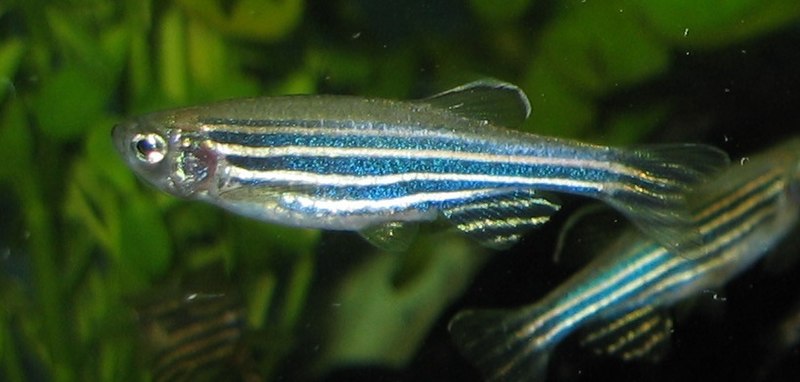
These guys are zebrafish (shown to the right in their normal colours) that have been genetically modified to express different FPs, causing them to fluoresce under different light. (White light works but blue light is best, I think.) You can see videos of them swimming about here. The original goal was to create fish that could be used for detecting environmental pollution etc. but, given restrictions on releasing GM animals into the wild, I think that fun fluorescing pets is probaby a more practical (and lucrative) application! Other GFP'd animals (usually for scientific reasons) include mice, monkeys, cats, pigs and, of course, Alba the GFP albino rabbit, although I am always a little wary of colour enhancement for images of such things. I'd still like to have one as a pet, though!

Tuesday, 22 November 2011

Where do new proteins come from?

As part of my second year lectures on protein evolution, I cover (albeit far too briefly) the topic of where new proteins come from. The most common answer to this question, is "other proteins". Gene duplication is common and happens at a variety of levels, from individual domains (independent folding units of proteins) to full length proteins, multiple proteins (on larger chromosomal stretches) to whole genome duplication, in which every single gene is duplicated.

Duplication is so important because it generates a copy that can remain essentially unchanged, performing the ancestral function, and a copy that is free to accumulate mutations. Often - usually - these mutations will ultimately disable one of the copies, generating what are known as "pseudogenes", the easily identified relics of past mutational dead ends. Occasionally, however, a new function will arise, such as the binding of a new enzyme substrate, the the reception of a different wavelength of light, and both copies will be retained. 

This is fascinating stuff in itself (and I may post more on it later) but it is not what I want to talk about here. Important as they are, duplications rely on something - an existing protein-coding gene - being there to be duplicated. Where do these proteins come from in the first place? Are all modern proteins just duplicated and edited versions of a suite of ancestral proteins? Does this mean that supporters of Intelligent Design community are right and that some kind of intelligent intervention is necessary to increase the repertoire of proteins that are available?

Well, no. Far from being a statistical improbable event unlikely to ever occur, the "de novo" creation of new proteins from non-coding DNA seems to be a reasonably common event. In an article just published in PLoS Genetics, for example, "De Novo Origin of Human Protein-Coding Genes" (PLoS Genet 7(11): e1002379), Wu, Irwin & Zhang describe sixty such proteins that appear to have arisen in the human lineage since we shared a common ancestor with chimps. 

This and other work in the area is nicely summarised in the same issue by Guerzoni & McLysaght in a two page article that is well worth the read, "De Novo Origins of Human Genes" (PLoS Genet 7(11): e1002381). The Wu paper itself builds on earlier work from the McLysaght lab, and they include a nice summary of the type of evidence the work looks for (see the paper for details):


It is important to bear in mind that not all of the sixty novel protein-coding genes might be "true positive" results in the strictest sense. As Guerzoni & McLysaght point out:
"The operational definition of a de novo gene used by Wu et al. means that there may be an ORF (and thus potentially a protein-coding gene) in the chimpanzee genome that is up to 80% of the length of the human gene (for about a third of the genes the chimpanzee ORF is at least 50% of the length of the human gene). This is a more lenient criterion than employed by other studies, and this may partly explain the comparatively high number of de novo genes identified. Some of these cases may be human-specific extensions of pre-existing genes, rather than entirely de novo genes—an interesting, but distinct, phenomenon."
Nevertheless, this is still the creation of de novo protein sequence, just not whole genes. Indeed, if one were to relax the criteria, how much more might this happen within proteins? Domains are frequently linked by disordered regions and also have a tendency to be flanked by intron/exon boundaries, making it quite plausible for extra exons to be picked up along their evolutionary journey. In some ways, therefore, this sixty is likely to be an underestimate. 

There are other issues with identification process itself that make real estimates difficult. For robustness, authors limit themselves to stretches of DNA that are present in both humans and chimps, to rule out the loss of an ancestral protein, rather than the gain of a human-specific one. Insertions and deletions ("indels") are quite common and actually account for most of the difference (in absolute genetic terms) between humans and chimps:
"It is now common knowledge human and chimpanzee DNA differ by only 1% (more accurately, they differ in 1%of alignable regions of genome, with a further 3% divergence due to lineage- specific indels)."
It is quite possible, therefore, that a few extra protein sequences have arisen in non-coding human-lineage DNA that was deleted in the chimp lineage. The other limiting factor - and probably one that has a greater impact - is that of protein annotation. Discovery relies on proteins that are annotated as such in the human genome. The problem here is that such annotations are normally made using conservation of proteins from other organisms - something that is, by definition, lacking for lineage-specific proteins. This issue is not insurmountable and there are sources of evidence that are used but it is still likely to result in underestimation.

An important caveat remains, however. Although we have some examples of de novo proteins that appear to have function, for the majority of them we have no idea what they do, if indeed they do anything at all. A more interesting question opens up of when do you define translated DNA as a protein? Leaky transcription and translation almost certainly happens (although I have no idea how much) and so we might be detecting stuff that is really there but only rarely. Alternatively, it might be consistently transcribed and translated but have no function whatsoever - a neutral mutation that has drifted randomly to high frequency but may have no long-term future.

These questions and issues are unlikely to be resolved soon. For now, we just know that de novo creation of proteins is more common than we used to think and is likely to be a substantial source of raw material on which natural selection (and random drift) can act to evolve new functions. What the ultimate fate of these proteins tends to be, only time will tell.

Sunday, 4 September 2011

It's not The Central Dogma, my dear Watson

Long before James Watson was stirring up controversy for making comments that could be construed as sexist, racist and pro-eugenics, he was creating problems of another kind. Problems that are still haunting molecular biologists to this day. Problems with The Central Dogma of Molecular Biology.

The "Central Dogma" is something that gets attacked on a regular basis. Attacks come both from scientists and Creationists. The former are trying to sex up their science a little in order to catch the eye of an editor from a "high impact" journal, or science news site. The latter get hung up on the term "dogma", under the mis-guided belief that overturning one cherished idea of contemporary biology somehow invalidates the rest, including evolution.

So, what is The Central Dogma [ominous timpani drum roll]? And why/how does it get attacked so much?

I must confess that I didn't really understand the fuss until I read an old post about it on Larry Moran's blog, Sandwalk. Why do people keep refuting/attacking an idea that is so obviously wrong? Furthermore, why is there still "The Central Dogma" if it is obviously wrong and gets refuted every couple of years? To be frank, I didn't concern myself too much with it because I am much more interested in ideas and mechanisms than the names given to those ideas and mechanisms. Now that I know what the problem is, however, I realise that I have a responsibility to help do something about it - at the very least to make sure that I teach my students the right thing.

The answer, it turns out, is disturbingly simple. When "The Central Dogma" gets refuted every few years, they aren't refuting The Central Dogma. At least, they are not refuting it as originally defined by genius and polymath, Francis Crick. Instead, they are refuting a badly redefined version his once student, James Watson. (I may be a bit harsh on James Watson but it seems very clear to me who the real brains behind the operation was.) Meanwhile, the original "proper" Central Dogma still hangs around because it has never been refuted.

Crick's original is defined thus:

"The Central Dogma. This states that once “information” has passed into protein it cannot get out again. In more detail, the transfer of information from nucleic acid to nucleic acid, or from nucleic acid to protein may be possible, but transfer from protein to protein, or from protein to nucleic acid is impossible. Information means here the precise determination of sequence, either of bases in the nucleic acid or of amino acid residues in the protein."

Crick, F.H.C. (1958) On protein synthesis. Symp. Soc. Exp. Biol. XII:138-163 quoted in Judson, H.F. The Eight Day of Creation, Expanded Edition (1979, 1996) p. 332. (quoted on Sandwalk blog.)


Note that it is explicitly sequence information that cannot get out again. In other words, a protein sequence is never reverse-engineered into the nucleotide sequence that encoded it. In a nutshell, there is no reverse translation. Now, that doesn't seem like a big deal to us now, precisely because it has not been disproven in over sixty years, but it was not such a trivial statement at the time.

The Watson version, which sadly gets repeated in lots of biochemistry textbooks (and I may have even repeated myself in the past), is just the sequential flow of genetic information during transcription and translation, e.g. DNA → RNA → protein, published in his 1965 book [Watson, J.D. (1965) The Molecular Biology of the Gene. W.A. Benjamin. Inc. New York]. This is the version that keeps getting "refuted" by reverse transcription, epigenetic etc. This model is not wrong - it does happen - but it is certainly not the only flow of information. Nucleotides and proteins both pass information to both nucleotides and proteins. But this is old news and certainly does not challenge any of the core principles of modern molecular biology or evolutionary theory. To pretend otherwise, is just dishonest. (Or ignorant.)

Larry Moran ends his blog post by appealing to all teachers of biochemistry and molecular biology to explicitly adopt the "correct" Crick version. After all, (a) he defined it first, and (b) his is right as a universal principle. I am inclined to agree and will be sure to point out the difference to my students in future. And if you come across authors claiming to have refuted "The Central Dogma", ask them: have you really?!

Saturday, 20 August 2011

Bug-Bombing Biofilms

This weeks's Science Now has a really cool example of the awesome power of genetics and genetic engineering. Published in Molecular Systems Biology, a paper by Nazanin Saeidi et al. describes the construction of a bacterial bomb designed to take out Pseudomonas aeruginosa, which is a nasty biofilm-forming human pathogen.

Traditionally, we think about bacteria a single-celled organisms but this is often not really the case. In many situations, populations of bacteria form multicellular masses called biofilms. These can be a big problem, particularly for human disease, because the biofilm structure can make the bugs resistant to regular antibiotic attack.

Bring in the Special Forces. Saeidi et al. took another bacterium - workhorse of the molecular biology lab, Escherichia coli - and pimped it out to be a Pseudomonas aeruginosa killing machine, using many of the own pathogen's weapons against it. Essentially, the system was comprised of three parts:

1. The E. coli were engineered to recognise the "quorum sensing" signals that the Pseudomonas naturally produce to communicate during biofilm formation.

2. The quorum sensing receptor was genetically wired up to a gene that produced a toxin, pyocin, that had been modified to kill Pseudomonas. (In fact, they modified the very toxin that Pseudomonas uses to kill other bacteria during biofilm formation.)

3. The sensor was also wired up to a self-destruct mechanism, switching on expression of a lysis protein that, once enough had accumulated, would cause the cell to burst.

The net result is an E. coli that can sense when it is near Pseudomonas biofilms and, once the density is high enough, will start producing the pyocin toxin and the self-destruct lysis protein. After a period of accumulation, the cell bursts and all the surrounding Pseudomonas are exposed to the toxin, hopefully killing them.

The paper was just proof of principle, really. They were able to kill 90-99% of Pseudomonas aeruginosa with their new bug-bomb but there are still a lot of hurdles to overcome before this could be considered as a treatment for Cystic Fibrosis and other biofilm-related diseases. For one thing, it is not clear how harmful the E. coli, itself a human pathogen, or its toxic cargo would be to the patient or the other "friendly" bacteria in their bodies.

Despite this, though, I still think it is cool. Just being able to engineer something like this that works is a demonstration of how awesome molecular biology and genetics is in the 21st Century. Even if human diseases cannot be targeted directly with such techniques, biofilms also cause problems outside the body, such as in water pipes or on surgical instruments, and having another potential weapon in the arsenal to fight them is always welcome.