Although this is my blog, I feel a bit funny about explicitly blogging about work stuff in a blatant "look at what I've done, please read/use/cite it!" fashion. I have therefore created a new blog explicitly for that side of things. Actually, it has existed for a while but not really had much content until today's post about SLiMMaker (my second solo excursion into python CGI). The blog is currently titled SeqSuite: open-source bioinformatics in Python and the central theme is the application and development of the various tools that I have cobbled together over the years, although I hope to diversify into other related stuff should time allow.
The main focus is actually SLiMSuite, which is the collection of short linear motif (SLiM) tools that I have been involved in developing. (The term "SLiM" will probably be my longest lasting contribution to science. It's weird seeing it start to appear in textbooks! (Although I must point out that I did not invent the concept. I'll save SLiMs for another post, I think.)) SLiMSuite is both the main pillar of my research but also, I think, the more original and unique of my software. (Some of the other stuff I have made because I have been too lazy to hunt down something that does what I want.)
Despite the ascendancy of SLiMSuite, I've stuck with "SeqSuite" as the name, though, as (a) other "Slim Suites" seem to exist and I want to head off any legal objections in advance, and (b) I have some other tools that are nothing to do with SLiMs and, along with SLiMSuite, form the larger SeqSuite package.
I'm still not entirely sure how the two blogs will work - finding the time to write one blog is hard enough - but I think I will continue to post the more "human" aspect of work-related matters here, and the more technical aspects on the SeqSuite blog. (Hopefully, I can convince some of my collaborators to contribute there too.) I think, like a lot of academics, I realise the importance of trying to communicate what we do, but haven't quite worked out yet the best way to go about it.
Sunday, 29 April 2012


Tuesday, 24 April 2012
CGI, where've you bin all my life?
I'd been meaning to play around with CGI (Common Gateway Interface) programming for some time as a way of making simple functional websites. I finally got round to it last month, thanks to a great introductory page at Tutorials Point. What I did not realise is quite how easy it was.
I've still only really scratched the surface and scanned over the page to get something up quickly but, in essence, you only need three things:
My first attempt at this can be found here. It's a bit of silly fun but it shows what can be done with just a few simple lines of code. I've cheated a little bit by using an existing python module to generate the middle of the HTML code but, in a way, that's the point - you can easily adapt existing functional code to output text.
In this case, I use the random "Zen wisdom" text strings that are generated in my code to lighten up error messages when I'm debugging. (If you ever use one of my programs, you sometimes come across such an error message, which always causes confusion (and usually embarrassment for me!) but I think it's a small price to pay for making debugging more fun!) The scary thing is how often the random Zen Wisdoms sound deep and meaningful, e.g.
I've still only really scratched the surface and scanned over the page to get something up quickly but, in essence, you only need three things:
1. A webserver that supports CGI.And that's essentially it. Actually, you don't even need (2), as you can feed variables directly to the cgi script, but it makes it easier for the user, I think.
2. An html page containing some "form" code that contains a submit button and (optionally) some input options (e.g. text boxes or checkboxes).
3. A python script (or another language) that generates HTML code based on the variables and values from the form.
My first attempt at this can be found here. It's a bit of silly fun but it shows what can be done with just a few simple lines of code. I've cheated a little bit by using an existing python module to generate the middle of the HTML code but, in a way, that's the point - you can easily adapt existing functional code to output text.
In this case, I use the random "Zen wisdom" text strings that are generated in my code to lighten up error messages when I'm debugging. (If you ever use one of my programs, you sometimes come across such an error message, which always causes confusion (and usually embarrassment for me!) but I think it's a small price to pay for making debugging more fun!) The scary thing is how often the random Zen Wisdoms sound deep and meaningful, e.g.
"It is bold to play jenga with blocks of passion."Well, maybe not that deep and meaningful!
Saturday, 21 April 2012
Move over CIA World Factbook, Globe-Town is here!
I don't know an awful lot about the World Bank but it has recently been drawn to attention that they currently have an "Apps for Climate Change" challenge. One of the entries is lead by Jack Townsend, a postgrad student in one of the labs that I collaborate with and part of the University of Southampton's Web Science Doctoral Training Centre. It's called Globe-Town and it's a really good-looking and user-friendly way to navigate around the World Bank Statistics:
 The blurb:


 Clicking on the different sub-categories then brings up some graphs looking at that particular metric over time and, perhaps most interesting at all, comparing the numbers relating to your country of interest with those of the highest and lowest countries. I'm not sure how great all of the underlying data is - you can get some weird things like 140% of children completing primary school - but Jack and co. cannot be blamed for this as it all comes from the World Bank.
All in all, this a fun, educational and informative site and well worth a vote for the App challenge.
The blurb:Modern life is making us next-door neighbours with far-away places. We share major risks, responsibilities & opportunities with countries around the world, something that is never more applicable than to climate change which connects us all through the environment we share. Globe-Town is a way of viewing information about the countries of the world and exploring how they are connected together. With Globe-Town we can learn about the places we depend upon most and discover what connects them to us.At the top of the page, you can pick a country and a climate-related statistic and get a nice visual on how that nation is connected to other countries. Below, Globe-Town offers data from the World Bank and rates them according to the World Average. These are divided into three categories: Society, Environment and Economy.


 Clicking on the different sub-categories then brings up some graphs looking at that particular metric over time and, perhaps most interesting at all, comparing the numbers relating to your country of interest with those of the highest and lowest countries. I'm not sure how great all of the underlying data is - you can get some weird things like 140% of children completing primary school - but Jack and co. cannot be blamed for this as it all comes from the World Bank.
 All in all, this a fun, educational and informative site and well worth a vote for the App challenge.
Monday, 16 April 2012
Short-cited VII: does Open Access publishing encourage bad science?
The argument about Open Access publishing is one that is going to run for some time, I am sure. (See yesterday's piece in The Economist, for example. One spectre that raise its ugly head from time to time, though, is the notion that Open Access is bad because it encourages bad science. In essence, the argument goes: Open Access is cheap for the publishers, therefore they are willing to publish anything. In support of this, I have seen people cite the high acceptance rates at PLoS and BioMedCentral of (apparently) 50-70% as an indicator that they will publish pretty much anything. I've even seen this used in favour of removing pre-publication peer-review altogether in favour of post-publication peer-review, as in the case of WebmedCentral - the implication being that, in the Open Access world, pre-publication peer-review is useless.
I think this is all rather unfair on Open Acess journals, especially the likes of PLoS and BMC. The latter have just done away with the need for the science to be deemed "interesting" as long as the science is sound. (And this for only some of their titles.) This is a far cry from publishing anything and peer-review being worthless.
The peer-review process involves highlighting things that need to be changed to meet the "scientific soundness" criterion. Most authors then go ahead and make the required changes, usually improving the paper as a result. I would argue that this is the single biggest utility of peer-review; as an author, I want to go through this process myself, even if it is sometimes irritating. The fact that PLoS and BMC publish 50-70% of papers just indicates that scientists are capable of producing scientifically sound work (following revisions) 50-70% of the time. The higher rejection rate at Science and Nature is more to do with what science is perceived as being of general interest, rather than the soundness or quality of the work. (I also suspect the acceptance rate for the flagship PLoS and BMC journals that do stipulate a need for impact is considerably lower than across the whole series.)
The peer-review process and quality of reviewers is not always perfect but it is still better than none at all. I am very reluctant to ever publish in a journal that does not have pre-publication peer review and it is not just about the journal's "Impact Factor"; the quality of the papers is going to be lower without the opportunity for revisions in the face of peer-review and at least the threat of being in that 30-50% that aren't deemed scientifically sound enough to publish.
The biggest problem in the modern scientific literature is the pressure on scientists to publish too soon and too often, not the presence of journals that are willing to publish boring science. Until we get rewarded for the quality of our science and not the quantity or impact of our papers (first is not always best), I cannot see this changing, sadly.
I think this is all rather unfair on Open Acess journals, especially the likes of PLoS and BMC. The latter have just done away with the need for the science to be deemed "interesting" as long as the science is sound. (And this for only some of their titles.) This is a far cry from publishing anything and peer-review being worthless.
The peer-review process involves highlighting things that need to be changed to meet the "scientific soundness" criterion. Most authors then go ahead and make the required changes, usually improving the paper as a result. I would argue that this is the single biggest utility of peer-review; as an author, I want to go through this process myself, even if it is sometimes irritating. The fact that PLoS and BMC publish 50-70% of papers just indicates that scientists are capable of producing scientifically sound work (following revisions) 50-70% of the time. The higher rejection rate at Science and Nature is more to do with what science is perceived as being of general interest, rather than the soundness or quality of the work. (I also suspect the acceptance rate for the flagship PLoS and BMC journals that do stipulate a need for impact is considerably lower than across the whole series.)
The peer-review process and quality of reviewers is not always perfect but it is still better than none at all. I am very reluctant to ever publish in a journal that does not have pre-publication peer review and it is not just about the journal's "Impact Factor"; the quality of the papers is going to be lower without the opportunity for revisions in the face of peer-review and at least the threat of being in that 30-50% that aren't deemed scientifically sound enough to publish.
The biggest problem in the modern scientific literature is the pressure on scientists to publish too soon and too often, not the presence of journals that are willing to publish boring science. Until we get rewarded for the quality of our science and not the quantity or impact of our papers (first is not always best), I cannot see this changing, sadly.
Sunday, 15 April 2012
Why the Titanic is a big deal to Southampton
There are several places that stake a claim to the RMS Titanic, which struck an iceberg one hundred years ago today (twenty minutes before midnight, ship's time) and sunk just over two and a half hours later with over one thousand people still on board. She was built in Belfast, set sail from Southampton, and last stopped at Cobh in Cork (Ireland), then called Queenstown. All three have Titanic museums, including the new Sea City museum in Southampton, which opened recently.
I think that Southampton stands out, however, because the claim is not really about prestige or fame but genuine heart-felt loss. The reason for this is quite simple and horrifying: four fifths of the crew and about a third of the 1514 who died came from the city. This is approaching 0.5% of the population of the city at the time. This is perhaps shown best at the Daily Echo interactive map of the Titanic crew victims and survivors from Southampton:

Another way to put things in perspective: in that one night, Southampton lost almost as many people as during the entire Blitz in World War II. (Southampton was bombed 57 times, destroying or damaging over 45,000 homes!) Some of the individual stories are worse even than this. At Northam School (near the current Saints stadium, St Mary's), for example, almost half of the 250 pupils lost their father in the disaster.
Living in Southampton, therefore, it seemed wrong not to write a short post about it. (Although, not coming from Southampton, I do not really think that I have a true sense of how the impact of the Titanic's loss is still felt.) So next time you are watching Kate and Leo in 3D, spare a thought for Southampton.
I think that Southampton stands out, however, because the claim is not really about prestige or fame but genuine heart-felt loss. The reason for this is quite simple and horrifying: four fifths of the crew and about a third of the 1514 who died came from the city. This is approaching 0.5% of the population of the city at the time. This is perhaps shown best at the Daily Echo interactive map of the Titanic crew victims and survivors from Southampton:
Another way to put things in perspective: in that one night, Southampton lost almost as many people as during the entire Blitz in World War II. (Southampton was bombed 57 times, destroying or damaging over 45,000 homes!) Some of the individual stories are worse even than this. At Northam School (near the current Saints stadium, St Mary's), for example, almost half of the 250 pupils lost their father in the disaster.
Living in Southampton, therefore, it seemed wrong not to write a short post about it. (Although, not coming from Southampton, I do not really think that I have a true sense of how the impact of the Titanic's loss is still felt.) So next time you are watching Kate and Leo in 3D, spare a thought for Southampton.
Friday, 13 April 2012
Eyes in their stars
 I'm currently working my way through Evolution's Witness: How eyes evolved by Ivan Schwab. When (if!) I've finished, I'll review it. So far, I am not entirely sure how much I like the writing style but it is certainly packed with great images and interesting facts.
One such interesting fact is the discovery (for me) that certain kinds of brittle stars (echinoderms that are closely related to starfish) have arms that are covered in eyes. One such critter is Ophiocoma wendtii (Picture from the Wiezmann Institute). These have all sorts of interesting abilities, such as being able to regenerate lost limbs (given their name, I guess this happens quite often) and some species reproduce by asexual fission of the central disc, producing two "daughters" with three long legs and, while they regrow, two short ones. I'm not sure if Ophiocoma wendtii is one that reproduces this way but it's the eyes that I'm interested in here!
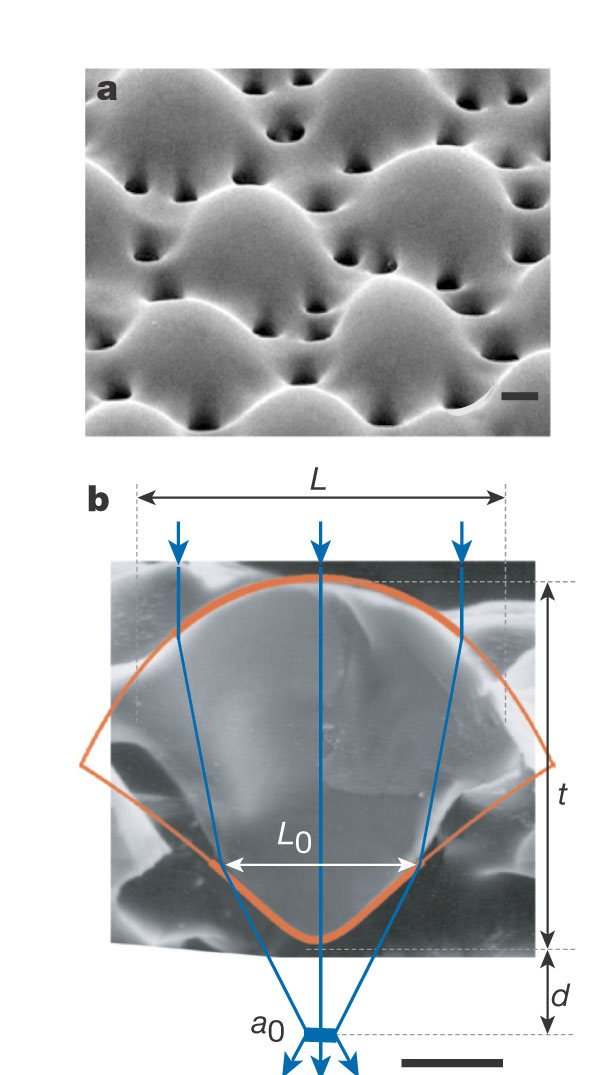
Left, is a scanning electron micrograph from Photonic structures in biology by Pete Vukusic & J. Roy Sambles (Nature 424, 852-855) of the top of one of the arms (top panel). Each bump is a separate "eye" featuring a calcite microlens that focuses light to photoreceptor cells within the arm tissue. These cover the surface of each arm, meaning that the brittle star can detect light across its whole body.
A close-up of an individual lens is also shown (bottom panel). (The scale bars are, 10μm, so these things are small!) The physics is a bit beyond me but these little eyes feature a "double-lens design" that "minimizes spherical aberration and birefringence that might otherwise degrade the optical function." In other words (I think), these critters get a fairly undistorted view of the direction that light is coming from.
Potentially, they can use the pattern of light and shade to help avoid predators. Perhaps more fun, though, they also use pigment-containing chromatophores to change colour at night in response to light levels. Not to shabby for an animal that we last shared an ancestor with over 500 million years ago!
Subscribe to:
Posts (Atom)