Wednesday, 1 May 2013

QSLiMFinder conference posters now up on F1000Posters

Although I have aspirations, I'm not very good at blogging about my work. I think this is partly because of my British squeamishness at self-promotion and partly because I can't decide where to start.

Having made a few posts about my recent(ish) visit to Cold Spring Harbor (and its geeky architecture/sculpture), I thought I should make at least one post related to the conference itself (the 2013 CSHL "Systems Biology: Networks" meeting. The two posters my lab presented have just gone live on F1000 Posters, which seemed as good an excuse as any:

  • Palopoli N & Edwards RJ. Improved computational prediction of Short Linear Motifs using specific protein-protein interaction data.
  • Edwards RJ & Palopoli N. Computational prediction of short linear motifs mediating host-pathogen protein-protein interactions.
  • I'll try to write a more informative post soon but, in the meantime, you can read the abstracts at my SeqSuite blog (or even click on the links to the posters) if you want to know more!

    Tuesday, 30 April 2013

    Charles Darwin, the gentleman scientist

    Yesterday, we went to Down House, the home of Charles Darwin, with a friend from the US. I've been meaning to go for a while and, as an evolutionary biologist, I guess it is something of a Pilgrimage. (Somehow fitting, therefore, that my Tom Tom Sat Nav decided to direct via all the country backroads, including Pilgrim's Way.) The house is now looked after by English Heritage and features some great exhibits and insights into the great man's life.

    As I am reading the blog of Darwin's Beagle diaries, I was initially most interested in the material from that time of his life, including the reconstruction of his cabin on the Beagle. Perhaps what struck me most, though, was Darwin the man, not Darwin the scientist.

    Darwin was a gentleman in every sense. It is true that he was independently wealthy and never had to work for his money, being the son of a very successful doctor and financier. Although he did not eschew this inheritance (honestly, who would?!) it is clear that he did not take his fortune for granted. I have already seen glimpses of his opposition to slavery in his journal comments but it was clear from Darwin House that he was also a kind employer to those paid to serve on his staff. His butler, Joseph Parslow, for example was described on his headstone as "Faithful servant and friend of Charles Darwin" and used to play billiards with Darwin. One of Charles Darwin's sons, Frances, wrote (quote taken from TwoJays):
    "“As a master of servants he was much loved and respected; he always spoke to them with politeness, using the expression "would you be so good" in asking for anything. And he was considerate in giving them trouble, one little thing I remember, how he used to reprove one for using a useless number of spoons because it gave so much more trouble in cleaning."
    On the subject of Darwin's children, the other thing that really came across from the house and the quotes taken from letters etc. was how much he cared for his family. Not only was Darwin a keen lover of nature, he was a loving husband and a doting father. It is not hard to imagine Down House and its gardens as the site of happiness and fun as well as some of the most influential science of the modern age.

    Critics of Darwin often try to make him out as some kind of monster, as if discrediting the man can discredit the science. Of course, this is nonsense on many levels. Newton, it seems, was a pretty nasty piece of work but his scientific genius remains. In Darwin's case, not only has the science stood the test of time but the character of the man himself deserves respect, whether you accept the scientific truth of evolution by Natural Selection or not.

    Sunday, 28 April 2013

    Are anti-vaxxers worse than Homeopaths?

    Vaccination has hit the news again recently following an outbreak of Measles in Swansea. Sadly, indications are that this might be the direct result of successful lies and scaremongering by the fraudulent Mr Andrew Wakefield (not "Dr", since he got struck off “dishonest, unethical and callous” behaviour) at the end of the '90s, which caused a lot of parents to avoid giving the MMR jab to their kids. (And he's not finished.)

    I don't generally go in for naming-and-shaming on this blog but if you are not familiar with Mr Wakefield's awful behaviour - and he still somehow seems to have supporters - I suggest you read this informative infographic by Darryl Cunningham, "The Facts In The Case Of Dr. Andrew Wakefield", or the more in depth expose by journalist Brian Deer. Not only did Wakefield fabricate data but he also had direct financial interests in seeing the MMR vaccine withdrawn. Bizarrely, far from being disowned by the anti-vax and alternative health community as a fraud and a miscreant, he has been embraced as a champion and hero of the cause.

    Anti-vaxxers come in three main flavours, as far as I can tell. First, there are the snake-oil salesmen, who are actively trying to raise funds and/or sell alternative medicine through their scaremongering. These are the worst of the set because they pretend to be campaigning for truth when really they are putting people at risk by spreading lies to line their own pockets.

    Second, there are the conspiracy theorists. These are deluded - often by the snake-oil salesman - into thinking that there is some giant conspiracy across science and healthcare professionals to lie to the public because we're all in the pocket of big pharma companies. (It is particularly ironic when these people support the likes of Andrew Wakefield, who was paid to discredit the MMR vaccine!) The tragedy here is that I suspect they are occasionally right about specific cases but, like the boy who cried wolf, who is going listen to them when blanket opposition to vaccination is so patently absurd? (I suspect this group also includes those who have been unfortunate enough to have a child suffer a rare condition or reaction and are looking for something more sinister than bad luck to blame.)

    Lastly, there are those who are in favour of living a more "natural" lifestyle and who have sadly been suckered in by the more militant anti-vaxxers in online forums and the like. They may not fully buy into the whole "vaccines are evil" conspiracy, but they have been sufficiently brainwashed regarding the perceived dangers of tried-and-tested vaccines - and dulled to the very real dangers of not being vaccinated - that they avoid vaccinating their own children. This last camp includes the author of the recent "Comment is free" column in the Guardian, "Why I wish my daughter had been vaccinated". I hope more people read it. The evidence is clear. Vaccination is one of the most important medical innovations in history and has saved countless lives. As the article points out, people can only afford to be so complacent about it in the 21st Century because it has been so successful.

    It is true that not all vaccines are 100% safe for 100% of people, and some of the stabilisers and adjuvants (immunity boosters) can have risks associated with them - which is why all new vaccines go through intensive testing, clinical trials and monitoring (as MMR has). These are not generally what the scaremongers are talking about, however, as they are generally not just opposed to new and unproven vaccines (indeed, they often promote their own unproven remedies) but instead trot out the same set of busted myths as a basis for opposing vaccination in general. These common myths are explained in "Six myths about vaccination – and why they’re wrong" from a great Australian site that I will be visiting again, The Conversation. (But you will still find them repeated.)

    There is a small but genuine minority of people for whom vaccination is not possible, usually due to an allergy or immune deficiency of some kind. These people - along with the other small minority for whom vaccination fails - are wholly dependent on "herd immunity" to keep those nasty diseases at bay. This is the very real phenomenon where a sufficient proportion of the population is immune such that the disease is unable to take hold and spread.

    By refusing to get their children vaccinated and discouraging others from doing so, anti-vaxxers are weakening the effects of "herd immunity" and out-breaks such as the current (and frankly embarrassing) UK measles outbreak in Wales are the result. You are not just endangering your own children, you put the children of others at risk, and that is just not fair. It's a bit like people who think that speed limits or the Highway Code do not apply to them. You can get away with such behaviour for a while so long as everyone else is following the rules because they are keeping you safe with their diligence. Whether born of ignorance or not, it's selfish, pure and simple.

    But what if you are worried that you are one of those - or might be - with a genuine bad reaction to vaccination? Don't you have the right to avoid that risk?

    No. First, bad reactions to vaccines are both rare and even more rarely as bad as getting the disease you are being vaccinated against. We tend to forget that because, ironically, vaccination has been so successful that incidents of these nasty diseases are themselves rare. Yes, you might be the unlucky one to experience a bad reaction - but you might equally be the unlucky one to get the life-threatening disease if there is a lack of herd immunity. Second, because of herd immunity, people with known bad reactions to vaccination should be even more pro-vaccination! Without the ability to get protection themselves, they are relying on the civil responsibility of others.

    I've blogged a few times about Homeopathy, a sham treatment of sugar pills or water with no scientific basis nor evidence for efficacy that (shamefully) is still offered on the NHS in some places. Most homeopathic treatments are targeted at fairly innocuous conditions and are usually sold alongside real medicine, so the main damage done is to your finances (and maybe your pride once you realise you've been scammed). Apart from the diversion of funds from legitimate treatments, however, the damage done to third parties by Homeopaths is minimal.
    "First, do no harm."
    These words, attributed to Hippocrates, nicely sum up the essence of the "Hippocratic Oath" that (ethical) practitioners of medicine generally swear to. Anti-vaxxers, in contrast, put innocents at risk, including those who have not embraced their twisted and deviant message of lies. For that reason I think, yes, they are worse than Homeopaths - at least if you buy into the hogwash of Homeopathy, you are usually only harming yourself. (Sadly, that's not always the case and reliance on homeopathic treatment can kill children too. I think the effects on society are smaller, though. That said, the lesser of two evils is still evil.)

    Saturday, 27 April 2013

    Mastering Wildlife Conservation with Marwell Zoo and the University of Southampton

    Although it's not quite formalised yet, Southampton has just announced an new Masters in Research course to start in October 2013. The MRes Wildlife Conservation is a joint venture between the University of Southampton and Marwell zoo, and represents a pretty unique opportunity (in the UK at least) to work closely with an active conservation organisation in the UK or Africa.

    Result!         [Photos from my September 2010 Marwell Zoo album.]

    Friday, 26 April 2013

    Happy DNA Day!

    It's 60 years to the day since the trio of Nature papers about the structure of DNA were published, including the famous 1953 Watson & Crick paper. The double helix has to be one of the most elegant and beautiful of all natural phenomena. The Exploratorium website has an annotated version of the Watson and Crick paper if you fancy a read. It's pretty short and contains one (or two) of the biggest understatements in biological history:
    "This structure has novel features which are of considerable biological interest. ... It has not escaped our notice that the specific pairing we have postulated immediately suggests a possible copying mechanism for the genetic material."
    Indeed!

    Monday, 22 April 2013

    Young Darwin at Cold Spring Harbor Laboratory


    Observant folks will have noticed a statue of a young Darwin outside the Luke Building in my earlier post about Cold Spring Harbor Laboratory. I like it. Normally, Darwin statues (such as at the Oxford University Museum of Natural History) are of the old Darwin, balding and beardy. I have been reading Darwin's Beagle Diary blog and so it's great to see a statue of the young Darwin striding forward into the unknown. (The 2nd voyage of HMS Beagle die not go via North America, so it's not commemorating an actual visit to Cold Spring Harbor.)

    In reading the diaries, I've been captured by the enthusiasm for nature that Darwin exhibits. A few quotes from his time in Bahia, Brazil in February/March 1832 give good examples.

    29th February 1832:
    "The day has passed delightfully: delight is however a weak term for such transports of pleasure: I have been wandering by myself in a Brazilian forest: amongst the multitude it is hard to say what set of objects is most striking; the general luxuriance of the vegetation bears the victory, the elegance of the grasses, the novelty of the parasitical plants, the beauty of the flowers — the glossy green of the foliage, all tend to this end. — A most paradoxical mixture of sound and silence pervades the shady parts of the wood, the noise from the insects is so loud that in the evening it can be heard even in a vessel anchored several hundred yards from the shore. Yet within the recesses of the forest when in the midst of it a universal stillness appears to reign. To a person fond of natural history such a day as this brings with it pleasure more acute than he ever may again experience."
    1st March 1832:
    "I can only add raptures to the former raptures. I walked with the two Mids a few miles into the interior. The country is composed of small hills & each new valley is more beautiful than the last. — I collected a great number of brilliantly coloured flowers, enough to make a florist go wild. — Brazilian scenery is nothing more nor less than a view in the Arabian Nights, with the advantage of reality. — The air is deliriously cool & soft; full of enjoyment one fervently desires to live in retirement in this new & grander world."
    5th Mar 1832:
    "It is a new & pleasant thing for me to be conscious that naturalizing is doing my duty, & that if I neglected that duty I should at same time neglect what has for some years given me so much pleasure."
    This is a side of Darwin's character that often seems to be forgotten when discussing his accomplishments with regards to evolution and it's good to have reminders from time to time. He was not just a great Scientist, he was a lover of Nature.

    Saturday, 20 April 2013

    Nature launches "pastcasts" with 1953 DNA papers - and unsung hero of the story, Raymond Gosling

    The Nature Podcast has added a new series: the Nature Pastcast, which revisits key papers from the Nature archives. The first episode looks at the famous 1953 Watson & Crick paper and the other two DNA papers from the same issue.

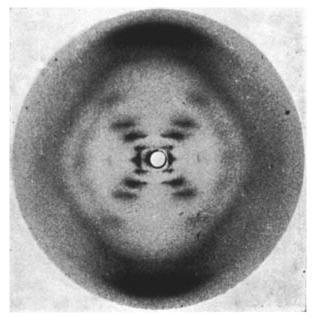
    Watson and Crick are rightly famous for the discovery of the structure of DNA. Maurice Wilkins, who was senior authors on one of the other papers in the issue and showed Watson the famous X-Ray diffraction image of "B DNA" ("Photograph 51" [image, above right, from Wikipedia]) shared the Nobel prize with Watson and Crick.

    Everyone also seems to know about Rosalind Franklin, whose group took the X-Ray image (but did not appreciate its significance) and many people was cheated of a Nobel prize because it is not awarded posthumously. There was another key player that I had never heard of until today, though, Raymond Gosling.

    Having listened to the podcast, if anyone should have shared the glory of the discovery it was Gosling. It was he who took the famous Photograph 51 and he who gave it to Wilkins, who in turn showed it to Watson. Franklin, it seems, was primarily interested in solving the "A" form of DNA, of which this was not an image. You can hear more of his story in his own words in a Nature Podcast Extra interview. Interesting stuff.