
Wednesday, 31 December 2014


Thursday, 25 December 2014
Best Christmas stocking chocolates ever!
 Like many - most? - people my age who grew up in the UK (and Ireland, I think), Christmas stockings are synonymous with Cadbury’s chocolate coins. However, this year was destined to be a Christmas without them, for two good reasons:
First, there was the report earlier this year that Cadbury are no longer making them. This had a considerable public backlash, as captured on Buzzfeed. (The author made one error in his post, ending: “However, all hope is not entirely lost, you can still buy different chocolate coins at supermarkets and pound stores around the country.” Sorry, but other chocolate coins suck in comparison.)
Second, Australian Cadbury’s chocolate is rubbish. (Sorry, Aussies, but it is. We’ve done blind taste tests and everything.)
Fortunately, Santa came up with a much better idea this year: spiced chocolate almonds from Haigh’s Chocolates.

These sound pretty amazing but are even better than they sound: an almond, encased in milk chocolate, encased in white chocolate and dusted with spiced dark chocolate powder (cinnamon, cloves, cardamon and star anise.) One to look out for next year!
Friday, 5 December 2014
Edwards Lab: On the hunt for molecular mimicry in viral pathogens
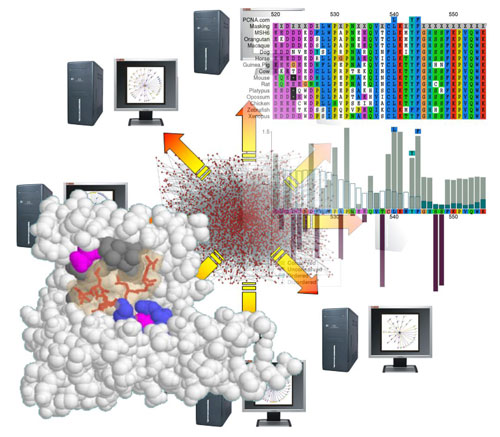 Yesterday’s excellent Australian Pathogen Bioinformatics Symposium 2014 (#APBS2014) reminded me that this post was a bit overdue: originally posted at the UNSW Science Wavelength blog on October 30, 2014. Following APBS2014, we are also looking into how we can identify which other pathogens might be using a similar strategy.
Read more at the Edwards Lab blog…
Saturday, 1 November 2014
Increase your mailbox and get a new massage
I just can’t understand the authors of phishing emails. Why go to all that trouble to mimic an Outlook full mailbox message and then not even bother to proof-read the English. Don’t con artists have any standards? It’s just insulting. (A massage would be nice, though.)

Wednesday, 29 October 2014
Sculpture by the sea is back

 We moved to Sydney just over a year ago and one of the first things we discovered was Sculpture by the sea 2013, an annual free public arts event in which one hundred or so artists create sculptures on the eastern coast from Bondi Beach to Tamarama Beach.
Even without the sculptures, the Coogee to Bondi coastal walk is an impressive piece of coastline and we are lucky to have it on our doorstep. The sculptures really add another dimension, especially the ones that make use of the terrain as part of the art. I’ve not yet seen all of the 2014 offerings, but some of my favourites have this element, including a small army of giant ants and some strange tentacled beasts, draped over the rocks.


 Another thing I really like is the use of materials by some of the sculptures. The giant tentacular monster, for example, is made from thousands of bottle tops (left). There may well have been an environmental statement here too, about the amount of plastic (and plastic bottles specifically) that wash up on beaches. There were also some fantastic wooden birds made from old bits of furniture etc.
Another material that always seems popular is super shiny metal, which reflects the viewer, landscape and/or bits of the art itself in interesting ways. Last year, for example, there were some invisible dogs on the beach. This year, the sculptures included some shiny metal cylinders that mirrored flat discs into surprisingly three dimensional images.

It was a glorious weekend for the most part and so the coastal walk sections were predictably crammed with people. If you have the opportunity (as we did last year) to go off-peak, it is highly recommended. I’m already looking forward to going back and seeing what I missed the first time around. More photos on Google+.

Monday, 20 October 2014
Do we need a bioinformatics dead links database?
Keith Bradnam on his ACGT blog has recently highlighted the irksome issue of “link rot” - the unfortunate but all-to-common scenario in which a publication points to a URL that ceases to exist after an oft-too-brief time has elapsed. (In severe cases, before the paper is even published!)
Personally, I think that journals need to take a bigger responsibility in maintaining the integrity of their publications. Surely it is not beyond a big publishing house to have a bot that systematically checks their published links once a week and reports and errors? Authors could be notified and/or online manuscripts updated. In severe cases where the URL is critical to the paper, such as databases and webservers, lack of repair could even lead to retraction.
The problem goes beyond publications, however. For (sometimes mysterious) reasons of their own, even established biological resources quite often change their URLs too. For example, Pfam embeds the Wikipedia entry for a domain into their pages. I was browsing the globin page last week and clicked on a link to see the entry in Interpro, only to be greeted with:
Sorry, the requested URL has changed
The requested URL: http://www.ebi.ac.uk/interpro/IEntry/ac=IPR002338
has moved to
/interpro/entry/IPR002338;jsessionid=BB50E35E3DD96F6C83B7AD432B8E2E2A
You will automatically be redirected to the correct URL in a few seconds. Please update your bookmarks.
It redirected OK but I wonder how long it will be before that redirect itself disappears… and how many Wikipedia articles and database cross-references run the risk of breaking.
Perhaps we need a database where bioinformaticians can report, track, update and hopefully fix all these rotten links? In the meantime, if anyone spots any in my own webpages or papers, please let me know!
The perils of having a (soft) cat
Why Evolution is True posted this cartoon from lunarbaboon last week:

It’s never stopped me going to work but I’d be lying if I said that something like this (without the shoes) had not delayed me going to bed once or twice.
Subscribe to:
Posts (Atom)